
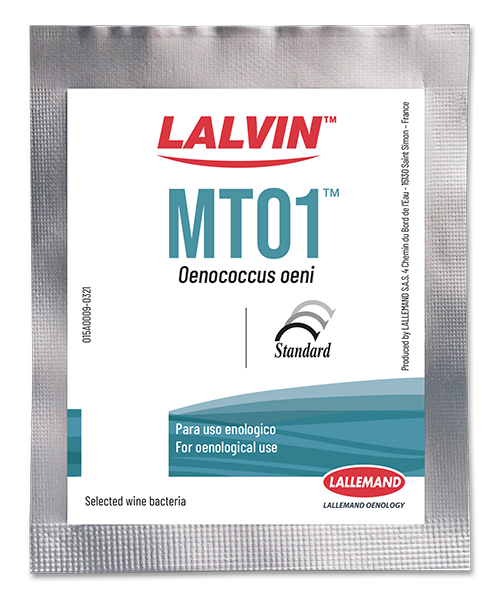

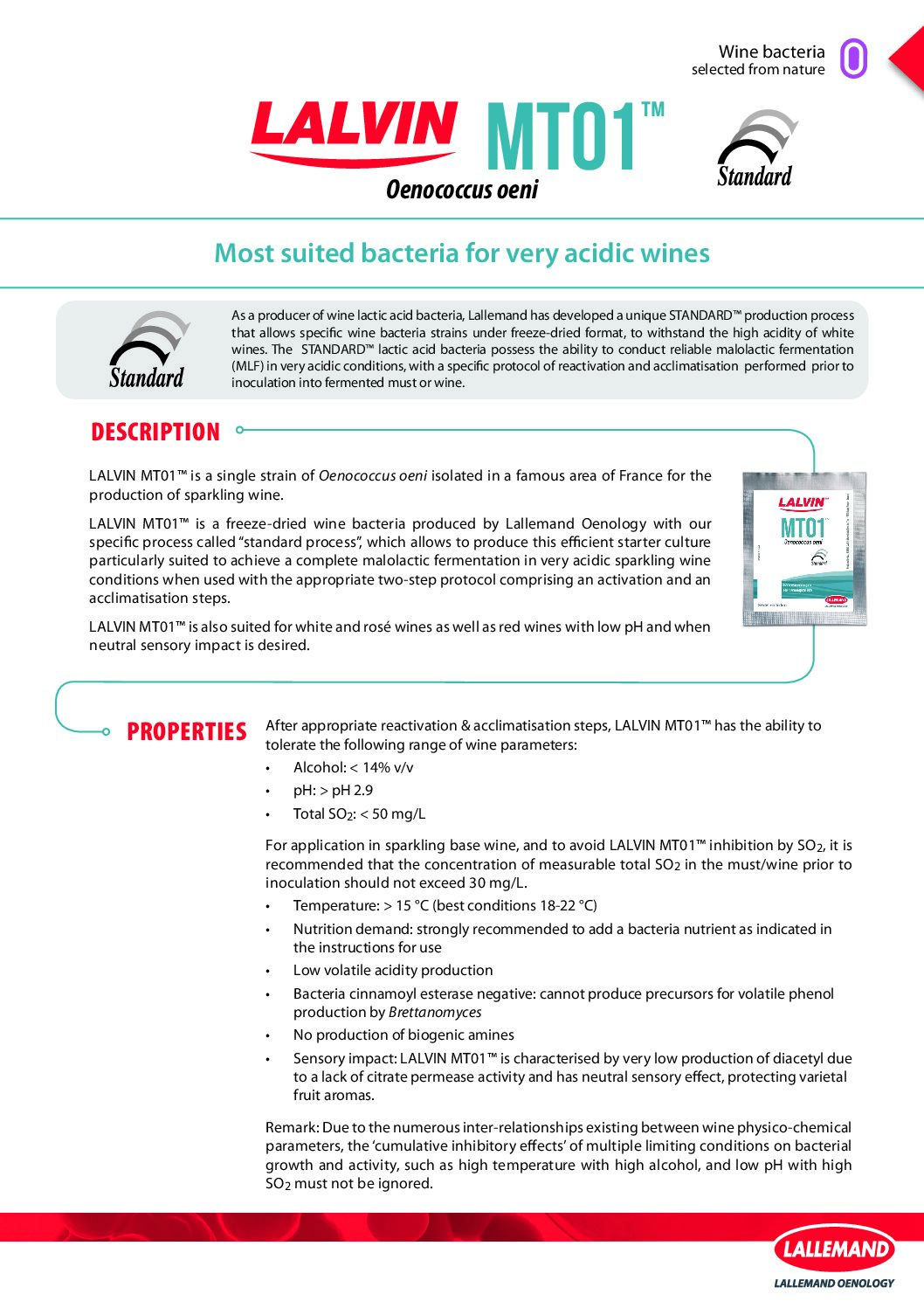
Malolaktiske bakterier – Lalvin MT01 – 25 gram til 2500 L (25 hL) specielt til vanskelig malolaktisk behandling af hvidvine og grundvine med pH 2,9-3,2 og højere (Lallemand, Canada)


1.500,00 DKK
In StockMalolaktisk behandling af sure Hvidvine og Grundvine til mousserende vine, der typisk har høj surhedsgrad med pH på 2,9-3,1, kan være vanskelige at malolaktisk behandling.
Typisk skal anvendes særligt syretolerance maloliske bakterier stammer af Oenococcus Oeni, som forhandles af flere at de store ønologiske produkt producenter , så som Novonesis (tidligere Chr-Hansen), Lallemand, IOC, SOE/OenoFrance, Laffort, AEB etc
En total oversigt over de væsentligste ,malolaktiske bakterie produkter har jeg samler i dette AI-Chat-GPT generel MLF-OVERSIGT Excel Master projektmappe: European_MLF_Master_OEM_Pricing_2026
Lallemand fremstiller malolaktiske bakterier med mange forskellige profiler og egenskaber. Heriblandt findes at produkt med en meget høj syretolerance som kan bruges ved malolaktisk behandling af sure “cold climate” hvidvine og specielt til grundvine til mousserende vine og cider med pH=2,9-3,2, men virke selvfølgelig også på vine med pH>3,2.
Langt de fleste danske/nordiske vine har meget højt indhold af æblesyre (malice acid), ofte grundet manglende fuldt modning og lave temperaturer i efteråret end det ses mere sydpå. Af disse grunde vil de fleste vine produceret her mod nord i “Cold Climate” zonen, opnå en bedre balance og kvalitet efter en malolaktisk behandling. Samtidig har stort set alt presset druemost og hovedparten af nordiske vine oftest en høj surhedsgrad med pH >3,2, hvilket betyder at en klassisk malolaktisk behandling med hovedparten af de produkter der findes på markeret ikke vil fungere,optimal uden forudgående kemisk afsyring med carbonat-salte, der let påvirker vinens kvalitet i en ugunstig retning (salt-tilførsel)
Databladet for Lalvin MT01 ses her: Lalvin MT01
Datablad for Acti-ML: Lalvin acti-ml-technical-datasheet-us-1738575170
Datablad for Calvin Opto Malo BLANC: OPTIMALO BLANC
SOP for brug af Lalvin MT01: SOP_MLF_MT01_50L_DA_E
SOP for brug af IOC Inobacter (alternativt produkt) : SOP_MLF_Inobacter_50L_full_PDC_multiday_DA_EN[14883]
SOP_MLF_Inobacter_50L_DA_EN_professional[14881]
Der anvendes typisk ca, 1 gram bakterier til 100 L vin
De frysetørrede bakterier opbevares nedfrosset og tøt indtil brug, men kan godt tåle opbevaring ved stuetemperatur i en kortere tidsperiode. Pas på fugt – levende biologisk materiale er kun stabilt i frosne tilstande en begrænset tidsperiode.
VinoSigns er eneste forhandler i Danmark af Lalvin-MT01 og det tilhørende Acti-ML reaktivator produkt og Opti Malo Blanc malonæring.
Beskrivelse
LALVIN MT01™ is a single strain of Oenococcus oeni isolated in a famous area of France for the production of sparkling wine.
Specificatiion Datasheet: Lalvin MT01
SOP for bruges af Lalvin MT01: SOP_MLF_MT01_50L_DA_EN
LALVIN MT01™ is a freeze-dried wine bacteria produced by Lallemand Oenology with ourspecific process called “standard process”, which allows to produce this efficient starter cultureparticularly suited to achieve a complete malolactic fermentation in very acidic sparkling wine conditions when used with the appropriate two-step protocol comprising an activation and anacclimatisation steps.
LALVIN MT01™ is also suited for white and rosé wines as well as red wines with low pH and when neutral sensory impact is desired
PROPERTIES
After appropriate reactivation & acclimatisation steps, LALVIN MT01™ has the ability to tolerate the following range of wine parameters:
Alcohol: < 14% v/v
pH: > pH 2.9
Total SO2: < 50 mg/L
For application in sparkling base wine, and to avoid LALVIN MT01™ inhibition by SO2, it isrecommended that the concentration of measurable total SO2 in the must/wine prior to inoculation should not exceed 30 mg/L.
Temperature: > 15 °C (best conditions 18-22 °C)
Nutrition demand: strongly recommended to add a bacteria nutrient as indicated in the instructions for use
Low volatile acidity production
Bacteria cinnamoyl esterase negative: cannot produce precursors for volatile phenol production by Brettanomyces
No production of biogenic amines
Sensory impact: LALVIN MT01™ is characterised by very low production of diacetyl due to a lack of citrate permease activity and has neutral sensory effect, protecting varietal fruit aromas.
Remark: Due to the numerous inter-relationships existing between wine physico-chemical parameters, the ‘cumulative inhibitory effects’ of multiple limiting conditions on bacterial growth and activity, such as high temperature with high alcohol, and low pH with high SO2 must not be ignored.
INSTRUCTION FOR USE:
Two steps are required to prepare an active, acclimatised starter culture of LALVIN MT01™ for inoculation into must or wine:
STEP 1: culture activation step and STEP 2: culture acclimatisation step
Prescribed volume of the activation medium: 0.2% of the total vat volume.
Prescribed volume of the acclimatisation medium: 3% of the total vat volume
Prescribed dose of LALVIN MT01™: 1 sachet of 25 g for 25 hL of total vat volume (final wine volume to be inoculated). The recommended dose of LALVIN MT01™ in these protocols allows to achieve a viable bacterial cell conc. of ≥106 cells/mL, that is required to initiate malolactic fermentation (MLF) and minimise delay to initiate MLF, thus reducing the risk of MLF failure.
Using the protocol with MUST, the culture activation step (A1) and the preparation of the acclimatization medium (B1) have to
be realized at the same time and each of both steps require 3 days, as described below
◗ STEP 1: CULTURE ACTIVATION STEP & PREPARATION OF THE ACCLIMATISATION MEDIUM
A1 CULTURE ACTIVATION STEP
Prepare culture activation medium as follows in a suitable vessel with airlock or cover•
2.5 L sterile grape or must or apple juice (low total SO2: less than 20 mg/L).•
2 L distilled or chlorine-free water at temperature 25 °C.•
Mix both and adjust to pH 3.2 – 3.3•
Add 2.5 g active dry yeast (LALVIN DV10™).•
Prepare a homogeneous suspension of bacterial nutrient ACTI-ML™ (50 g) in 500 mL clean, chlorine-free water at 20 °C. Mix in & rehydrate the full amount of one sachet of LALVIN MT01™ (25 g) into the 500 mL ACTI-ML™ suspension.
Stir gently and wait for maximum 15 minutes before inoculating the activation medium.
Culture Activation step
Add this rehydrated bacterial/nutrient suspension into the 4.5 L of culture activation medium.
Incubate for 72 hours (3 days) at 23-25 °C (CRITICAL STEP), with occasional gentle mixing over the incubation period.
Culture is ready for transfer into next phase at maximal turbidity and when malic acid is less than 1 g/L (foaminess and a lactic aroma are evident).
B1 During the same time: PREPARATION OF 75 L OF ACCLIMATISATION MEDIUM WITH MUST in a suitable vessel or tank with minimal ullage
75 L of must non chaptalised with low total SO2 (less than 20 mg/L) at temperature at 25 °C.
Adjust to pH 3.1 – 3.2 if needed
Start the alcoholic fermentation with 15 g of the active dry yeast LALVIN DV10™ previously rehydrated in a mix must/water (1/2 h at 37 °C).
Add 15 g of OPTI’MALO BLANC™ previously rehydrated in 200 mL clean water & then mix well into the must.
Ferment during the 3 days (duration of the activation step) and maintain the temperature of alcoholic fermentation at 20 – 25 °C
◗ STEP 2: ACCLIMATISATION STEP
After 3 days of activation, the activated bacteria culture (5 L) is ready to be inoculated in the acclimatisation medium (75 L) already in fermentation for 3 days (see preparation above).
Add the whole activation medium (total 5 L) into the 75 L of fermenting wine prepared and mix well. As soon as the alcoholic fermentation is finished, maintain the temperature at 20 °C to achieve the malolactic fermentation.
Let stand at 20 °C until 2/3rd of the L-malic acid is metabolised, or when the residual L-malic acid approaches 1 g/L.
If malic acid analysis on-site is not available to guarantee immediate results, the culture can be assumed to be ready when CO2 evolution is evident, and a slight lactic aroma is detected (CRITICAL STEP).
Note: if the final wine to be inoculated has difficult MLF conditions (e.g., low pH), it is highly recommended that this step is repeated by
sequential doubling of culture volume with wine to allow the bacteria culture to further acclimatise – the total volume will be 160 L
INSTRUCTIONS FOR OENOLOGICAL USE
STARTER CULTURE PREPARATION WITH MUST TO INOCULATE 25 HL OF WINE
STEP 1Wine bacteria selected from nature
◗ STEP 3: INOCULATION OF ACCLIMATISED CULTURE INTO FINAL WINE
Prepare 2,500 L final wine for inoculation
Prior to inoculation of the acclimatised culture, ensure that wine physico-chemical properties are appropriate for LALVIN MT01™ (pH > 2.9, total SO2 < 50 mg/L, alcohol <
14% v/v), and temperature is adjusted to 18-20 °C.
To ensure an adequate supply of bacterial nutrients and to assist the malolactic cultureto survive the final wine environment, we recommend using the bacterial nutrient
OPTI’MALO BLANC™ (dose rate 20 g/hL calculated on final wine volume) e.g. for 2,500 L wine, suspend 500 g of OPTI’MALO BLANC™ in 5 L clean water & add to the final wine.
Final inoculation: after the acclimatisation step, the malolactic culture is ready to be transferred into final wine volume with gentle mixing.
Maintain temperature at 18-20 °C
Check the degradation of malic acid
At the end of MLF, rack off and adjust the SO2.
Additional precautions are necessary about the risk of oxidation of wines during all the steps. Assure that the vessel or tank are full of wine. In case of mixing, stir gently to avoid excessive oxygenation, and monitor the wine’s temperature as indicated below.
◗ STEP 1 : CULTURE ACTIVATION STEP
Prepare culture activation medium as follows in a suitable vessel with airlock or cover
2.5 L of moderately sulphured wine (no free SO2 and total SO2 between 20 and 30 mg/L), with a pH close to 3.2.
2 L of hot chlorine-free water to obtain a mixture (wine + water) whose temperature is around 25 °C
Prepare an homogeneous suspension of bacterial nutrient ACTI-ML™ (50 g) in 500 mL clean, chlorine-free water at 20 °C. Mix in & rehydrate the full amount of one sachet of LALVIN MT01™ (25 g) into the 500 mL ACTI-ML™ suspension. Stir gently and wait for maximum 15 minutes before inoculating the activation medium.
Culture Activation step
Add this rehydrated bacterial/nutrient suspension into the 4.5 L of culture activation medium.
Incubate for 72 hours (3 days) at 20 °C (CRITICAL STEP), with occasional gentle mixing over the incubation period.
Maintain temperature at 20 °C until the malic acid content has been totally consumed (<0.2 g/L) then incorporate into the acclimatisation medium prepared for the step 2.
◗ STEP 2: ACCLIMATISATION STEP
Preparation of 75 L of wine for acclimatization step as follows in a suitable vessel with airlock or cover
Remove 75 L of wine from the vat that has finished its alcoholic fermentation and with a degree of alcohol lower than 13% vol. The pH of the wine should be close to 3.2. If not, de-acidify it using potassium bicarbonate. The amount of total SO2 should be below 30 mg/L and the content of free SO2 should be practically zero.
The temperature of the wine must be between 20 and 22 °C.
Add 15 g of OPTI’MALO BLANC™ (suspend it in 150 mL clean water & then mix well into the wine)
Then, add at the top of the tank, the activation medium with bacteria starter culture, without stirring.
Maintain the temperature at minimum 20 °C
Check the degradation of malic acid, until 2/3rd of the L-malic acid is degraded.
At this stage, inoculate the final tank of wine according to the protocol indicated below
Note: if the final wine to be inoculated has difficult MLF conditions (e.g., low pH), it is highly recommended that this step is repeated by
sequential doubling of culture volume with wine to allow the bacteria culture to further acclimatise – the total volume will be 160 L
STARTER CULTURE PREPARATION WITH WINE TO INOCULATE 25 HL OF WINE
STEP 2
STEP 3
A1
WAIT FOR 3 DAYS (check malic acid content)
before inoculating STEP 2
After 15 mn
When 1g/L of malic acid content
(75 L)
wine
+ 15 g
Opti-Malo Blanc
2500 L
wine
+ 500 g
Opti-Malo Blanc
ACTI-ML 50G
+LALVIN MT01 25G
0.5 L
Water
Total SO2 < 20 mg/L
pH= 3.2 – 3.3
Temp = 20°C – 22° C
Total SO2 < 30 mg/L
pH= 3.2
Temp : 20°C – 22°C
2 L Water
+ 2.5 L wine
20°C
pH= 3,1 – 3,2
Total SO2 < 50 mg/L
Temp : 18°C – 20°C
pH > 2.9
STEP 1Visionary biological solutions – Being original is key to your success. At Lallemand Oenology, we apply our passion for innovation, maximize our skill in production and share our expertise, to select and develop natural microbiological solutions. Dedicated to the individuality of your wine, we support your originality, we cultivate our own.
www.lallemandwine.com
Wine bacteria selected from nature
◗ STEP 3: INOCULATION OF ACCLIMATISED CULTURE INTO FINAL WINE
Prepare 2,500 L final wine for inoculation
Prior to inoculation of the acclimatised culture, ensure that wine physico-chemical properties are appropriate for LALVIN MT01™ (pH > 2.9, total SO2 < 50 mg/L, alcohol < 14% v/v), and temperature is adjusted to 18-20 °C.
To ensure an adequate supply of bacterial nutrients and to assist the malolactic culture to survive the final wine environment, we recommend that the bacterial nutrient
OPTI’MALO BLANC™ (dose rate 20 g/hL calculated on final wine volume) e.g. for 2,500 L wine, suspend 500 g of OPTI’MALO BLANC™ in 5 L clean water & add to the final wine.
Final inoculation: after the acclimatisation step, the malolactic culture is ready to be transferred into final wine volume with gentle mixing.
Maintain temperature at 18-20 °C
Check the degradation of malic acid
At the end of MLF, rack off and adjust the SO2.
When 1g/L of malic acid content
(75 L)
wine
+ 15 g
Opti-Malo Blanc
2500 L
wine
+ 500 g
Opti-Malo Blanc
Total SO2 < 30 mg/L
pH= 3.2
Temp : 20°C – 22°C
pH= 3,1 – 3,2
Total SO2 < 50 mg/L
Temp : 18°C – 20°C
pH > 2.9
STEP 2
STEP 3
The information in this document is correct to the best of our knowledge. However, this data sheet should not be considered to be an express guarantee, nor does it have implications as to the sales condition of this product. January 2022.
Distributed by:
PACKAGING & STORAGE
Product in powder form obtained by lyophilisation.
Available in dosage for 25 to 35 hL (sachet 25 g) and for 500 to 700 hL (sachet 500 g).
Once opened, wine bacteria sachet must be used immediately.
This product can be stored for 18 months at 4 °C/40 °F or 36 months at -18 °C/O °F in original sealed packaging.
Sealed packets can be delivered and stored for 3 weeks at ambient temperature (<25 °C/77 °F) without significant loss of viability.